Pamela Asai Art
  • Gallery
  • SALES
  • Shop for Prints
  • Poetry
  • About
    • Artist's Statement
    • Resume
  • Blog
  • News

The Artist's Chop

1/11/2022

0 Comments

 
​Have you ever noticed an embossed symbol at the bottom of an artist’s print?
Maybe you’ve seen little red stamps on old Chinese or Japanese artwork?
These are called chops in English. The word comes from the Hindi word chaap, meaning stamp, imprint, seal or brand, or instrument for stamping. It entered English via India in the early 19th century, referring to a trademark.
 
Stamps and seals have been used for millennia as a mark of authenticity. In Japan today, these signature stamps, called Hanko, are more important than a personal signature, and are used for banking, signing contracts and official documents, and even receiving parcels.
 
Picture

​Chops, which can be made from clay, wood, rubber, or linoleum, are usually relief printing blocks, pressed into ink and stamped onto the surface of the paper. Traditionally, they use indelible red ink, and on art works the mark frequently forms part of the design, as well as being a signature.
​
Picture
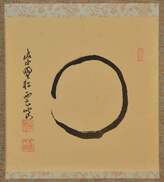
Early 20th Century Enso circle by Zen Master Shuhan Genpo
​
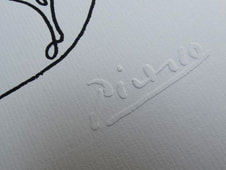
It is a tradition in Western printmaking for blind embossed stamps, also called chop marks, to be used as a sign of authenticity and quality. Blind stamping means embossing paper, without ink, using a unique stamp with a special press. It is very difficult to forge a blind stamp, as it becomes an integral part of the paper and the art work and cannot be removed.
 
The fine art print trade is obviously very concerned to ensure authenticity, and many print studios have their own unique blind stamp to emboss their prints and give them provenance. Also, if the artist hasn’t signed the print, the stamp proves that it is genuine.
 
These stamps can also be added to original prints by the artist, or by a collector. ​Galleries who manage an artist’s estate have chops made for that artist to authenticate the prints of their work.​
​
Picture
A blind embossed stamp of Picasso's signature.

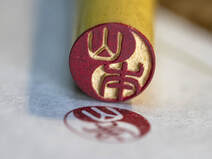
​So what has this to do with me? Well, I have started having fine art prints made of my work by Printroom Editions, a highly professional and experienced studio specialising in the printing of original art work. On their recommendation, I have had my own chop made. As well as signing and numbering my prints, I am also having them blind embossed, with my own ‘signature’ chop.
​
Picture
My chop

​​It looks beautiful when it is embossed onto the print. The white-on-white mark sits quietly in the bottom left-hand corner of the heavy printing paper. I love running my fingers over it. Embossing is really more of a tactile experience than a visual one, don’t you think?
 
The design of my stamp is inspired by the Japanese enso.
 
Also known as the Zen circle or infinity circle, it is one of the richest symbols of Zen Buddhism and one of the most common subjects of Japanese calligraphy.

Using a bamboo brush and ink, it is traditionally drawn using only one, swift, continuous brushstroke as a meditative practice for letting go of the mind and allowing the body to create. It is a manifestation of the artist, and their context, at the moment of creation – breath, hand, body, and mind – in the world, in that moment.

​In Zen philosophy, it is the revelation of a world of the spirit without beginning or end, reflecting the transforming experience of enlightenment - perfectly empty yet completely full.

Picture
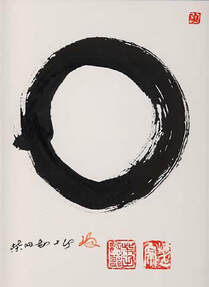
Enso by Kanjuro Shibata (c 2000)

​An enso may be open or closed. The closed circle can, among many things, mean the totality of the  experience of life, and the cycle of birth and death that continues endlessly. The incomplete circle allows for movement and development, as well as representing an acceptance of the imperfection of all things.

I have chosen an incomplete enso for my chop, to express the sense of my creative life as something that is always becoming through an exploration of the beauty and wonder of imperfection within each moment.

​Thank you for reading.

0 Comments


Leave a Reply.

    Pamela Asai

    Australian visual artist and poet, currently living in Japan. (2024-26)

    Archives

    November 2022
    July 2022

    Categories

    All

    RSS Feed

Powered by Create your own unique website with customizable templates.
  • Gallery
  • SALES
  • Shop for Prints
  • Poetry
  • About
    • Artist's Statement
    • Resume
  • Blog
  • News